
Introduction
People walk into dental offices every day with the same question: will veneers straighten my teeth? The answer isn’t straightforward. Marketing materials promise dramatic smile transformations in just weeks. Reality tends to be more nuanced. Social media influencers show off perfect teeth after veneer placement, making it seem like a simple fix for any dental problem.
Veneers work remarkably well for certain dental problems. For others, they’re the wrong tool entirely. A veneer changes tooth appearance, how it looks when someone sees your smile. The actual position of that tooth in your jaw? Unchanged. This distinction becomes critical when planning treatment. Patients sometimes expect veneers to work like orthodontics, which they don’t. Understanding what veneers can and cannot accomplish helps set realistic expectations from the start. Making informed decisions about cosmetic dentistry requires knowing the difference between appearance and structure.
How Veneers Work
In simple terms, veneers are ultra-thin ceramic shells permanently bonded to the front of the teeth. The material’s translucency mimics enamel optical properties reasonably well. Modern manufacturing techniques produce veneers that blend seamlessly with surrounding natural teeth when properly designed and placed.
Dentists take impressions or digital scans, after that labs fabricate custom veneers and patients return for bonding appointments (2). Tooth preparation removes roughly 0.5mm of enamel, sometimes less, occasionally more depending on the clinical situation. Once you remove enamel, there’s no going back. The tooth needs permanent coverage. Some newer veneer systems advertise minimal or no preparation, but most cases still require at least slight enamel reduction to avoid bulky results.
A rotated lateral incisor stays rotated after veneer placement. What changes is surface contour. Dentists can build out the lingual aspect to make the facial surface appear aligned from straight-on viewing angles. Studies show porcelain veneers lasting 10-15 years on average. Some patients get 20+ years from them with good hygiene habits (1, 2). The longevity depends heavily on proper case selection, quality of placement, and patient maintenance.
Veneers for Crooked Teeth
Minor rotations, maybe 8-12 degrees, respond decently to veneer treatment (2). Small gaps between centrals. One tooth sitting slightly forward of the arch. These cases work because the bite functions normally. Posterior teeth meet correctly. Canines guide properly during lateral movements.
The problem stays cosmetic rather than functional. Veneers reshape what people see during conversation. Literature describes this clearly—veneers handle slight irregularities, not major malpositions (1). One systematic review states that veneers mask only slight misalignment and color changes, while radical corrections require alternative methods (1). That’s not marketing spin. It’s a clinical reality.
Crossbites need orthodontics. Crowds over 5mm need orthodontics. Rotations past 20 degrees need orthodontics. Research lists severe occlusal problems as contraindications for veneer treatment (1). You can’t fake functional occlusion by reshaping front surfaces. Attempts to do so typically fail within a few years—either the veneers fracture from abnormal forces, or patients complain about the bulky, unnatural appearance.
Timelines differ dramatically between approaches. Veneer treatment takes 2-3 appointments over about three weeks (2). Orthodontics runs 6-24 months depending on case complexity. Braces move teeth through bone—permanent positional changes. Veneers just cover existing positions.
Veneers for Chipped Teeth
Enamel chips and fractures represent classic veneer cases (1, 2). Someone bites a popcorn kernel wrong. Basketball elbow to the face. Years of nighttime grinding wearing down incisal edges. The veneer covers damaged areas while preserving remaining tooth structure—more conservative than full crowns when appropriate. Patients appreciate avoiding extensive tooth reduction when their teeth are otherwise healthy.
Common applications: traumatic chips from accidents or sports, attrition patterns from parafunctional habits, worn incisal edges making teeth look short, discolored old composite fillings visible during smiling (2). Dental literature lists enamel cracks and chips among standard veneer indications. Makes sense clinically. The restoration replaces only what’s damaged or unsightly rather than covering the entire tooth.
Porcelain resists staining better than composite materials (2). Coffee, red wine, tea—porcelain handles these better long-term. The optical properties match enamel closely enough that results look natural rather than fake. Small chips under 2mm sometimes work better with direct composite bonding. Single visit. Lower cost. Tradeoff is durability—composite lasts 3-5 years typically. Porcelain goes 10-15 years (1, 2).
Severe chip or knocked-out tooth? That’s an emergency dentist visit, not a veneer consultation. Get urgent care first.
Limitations and When Not to Use Veneers
Veneers don’t correct malocclusions. Class II or Class III skeletal patterns need orthodontics or possibly orthognathic surgery. Anterior open bites need orthodontics. Posterior crossbites need orthodontics. Changing how teeth look from the front doesn’t fix how maxillary and mandibular teeth meet during function.
Teeth need adequate remaining structure. Loss exceeding 50% typically requires full crowns instead (2). Crowns cover the entire clinical crown—more tooth reduction but better for severely compromised teeth. Some situations need root canal treatment first.
Bruxism patients break veneers. Fracture represents the most common complication in published studies (1). Heavy parafunctional forces exceed what thin porcelain can withstand. These patients absolutely need nightguards. Without guards, veneers crack within 2-3 years despite otherwise good care (1). Veneers also don’t treat caries, periodontal disease, or pulpal pathology. Those need to be fixed before cosmetic work.
Alternatives for Crooked Teeth
Orthodontics remains standard treatment for malocclusion. Fixed appliances or aligner systems move teeth through alveolar bone using controlled forces. Treatment duration varies—6 months for simple cases, 18-24 months for complex corrections. Aligners offer aesthetic advantages over metal brackets but require patient compliance. Wearing them 20 hours daily is essential for predicted outcomes.
Direct bonding works for minor chips and small spaces. Chairside application in one visit. Lower cost than lab veneers but shorter lifespan—maybe 5 years before replacement becomes necessary due to staining or fracture. Full crowns become appropriate for heavily restored teeth or those with endodontic treatment.
Treatment comparison:
| Method | Corrects | Treatment Time | Durability | Notes |
| Porcelain Veneers | Minor chips, surface cracks, rotations under 15 degrees, diastemas under 3mm | 2-3 weeks, 2-3 visits | 10-15 years average (1) | Excellent aesthetics; permanent enamel removal; anterior teeth |
| Fixed Braces | All malocclusion types, skeletal discrepancies | 6-24+ months | Permanent with retention | Corrects tooth position; metal brackets visible |
| Clear Aligners | Mild-moderate crowding, rotations, spacing | 12-18 months typically | Permanent with retention | Aesthetic option; needs compliance; removable |
| Composite Bonding | Small chips under 2mm, minor reshaping | Single appointment | 3-5 years | Minimal invasiveness; lower cost; stains faster |
| Full Crowns | Severe damage over 50%, endodontically treated teeth | 2-3 weeks, 2 visits | 10-15 years | Full coverage; maximum strength; extensive reduction |
Evidence and Statistics
A 2020 systematic review analyzed veneer survival across multiple studies. Ten-year survival reached 95.5% when including all failure modes—fractures, debonding, biological complications (1). Most failures happen early, within the first two years after placement.
Fracture represents the main complication, especially affecting incisal edges and margins where porcelain measures under 0.5mm thickness (1). These numbers come from properly selected cases. Patients with significant malocclusion or inadequate tooth structure show much lower success rates. Bruxism patients who wear nightguards consistently keep their veneers significantly longer than those who don’t (1).
Before and After: Realistic Expectations
Understanding what veneers can realistically achieve helps patients make informed decisions. Case examples illustrate typical outcomes for different situations.
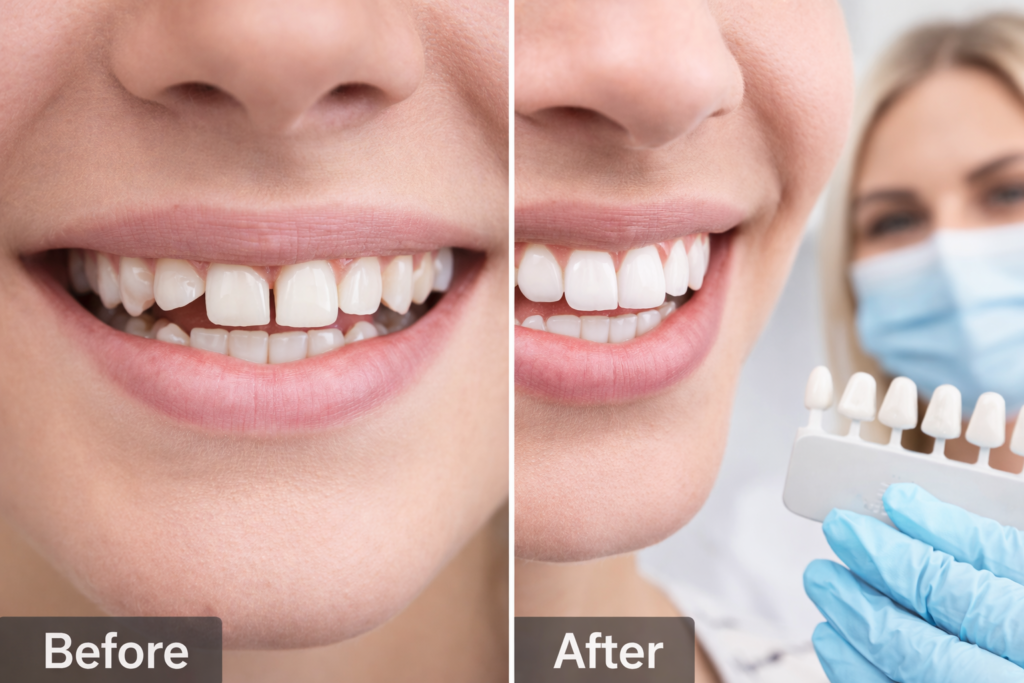
Minor spacing corrections respond well. A patient with a 2mm diastema between central incisors gets two veneers that close the gap completely. From the front, the smile looks seamless. Treatment takes three weeks. The teeth weren’t moved, the veneers simply fill the space. This works because the gap was small and the adjacent teeth had good alignment otherwise.
Chipped incisors represent another successful scenario. An athlete chips a front tooth during competition. The fracture removes about 30% of the incisal edge. A veneer restores the original tooth length and contour. Color matching ensures the restoration blends with adjacent teeth. Patients leave satisfied because the repair looks natural and feels smooth.
Mild rotations sometimes work, sometimes don’t. A lateral incisor rotated 10 degrees can look straighter with a veneer that builds out the recessed surface. The tooth still sits at an angle, but frontal appearance improves significantly. A central incisor rotated 25 degrees? Veneers produce bulky, unnatural results. That tooth needs orthodontic correction first.
Discoloration cases typically succeed when underlying tooth structure remains sound. Years of tetracycline staining that didn’t respond to whitening get covered with porcelain veneers. The transformation looks dramatic—gray-brown teeth become uniformly white. These cases work because the problem was purely aesthetic, not structural (2).
Less successful outcomes occur when veneers get pushed beyond their design limits. Attempting to mask severe crowding with veneers creates thick, prominent-looking teeth that patients dislike. Trying to correct a 4mm overbite with veneers alone fails because the bite relationship hasn’t changed. These patients waste time and money on the wrong treatment.
Realistic expectations matter. Veneers improve what people see during normal social interaction—talking, smiling, laughing. They don’t fix how teeth meet during chewing. They don’t change root positions. Patients who understand these distinctions tend to feel satisfied with results. Those expecting orthodontic outcomes from cosmetic dentistry typically feel disappointed.
Frequently Asked Questions
Will veneers make crooked teeth look straight?
For mild malpositions—rotations under 15 degrees, diastemas under 3mm, slight crowding not affecting posterior occlusion—veneers can create straight-looking results (1, 2). They reshape visible surfaces without moving teeth in their sockets. From a frontal view during normal conversation, the smile appears corrected. Severe misalignment needs orthodontics for functional, stable correction.
How long do veneers last
Studies show that properly made porcelain veneers will last -around 10 to 15 years on average (1,2) , but some people are lucky enough to get more than 20 years out of them, all it really takes is some good oral hygiene and regular dental checkups. The main factors that affect how long your veneers last are the quality of your oral hygiene, your eating habits, whether you’ve got any bad habits like grinding your teeth and how well you stick to a regular maintenance schedule with your dentist . If you’ve got bruxism you’ll need to get a night guard – without one your veneers will probably start to crack within 5 years even if you’re taking good care of them otherwise (1)
Can veneers fix severely chipped teeth?
Depends on remaining tooth structure. Veneers work when over 50% of the crown remains intact (2). Greater loss typically requires full crowns for adequate strength restoration. Dentists evaluate each case individually based on the extent of damage, location of remaining tooth structure, and occlusal forces at that tooth position.
Are veneers better than braces?
Different tools for different problems. Orthodontics permanently moves teeth and corrects malocclusion, which takes months to years. Veneers improve appearance quickly but only mask cosmetic issues without changing tooth position or bite (1, 2).
Do veneers require grinding teeth?
Yes. Preparation removes approximately 0.3-0.7mm of facial enamel (2). Much less aggressive than crown preparation, which removes 1.5-2mm circumferentially. Once done, the tooth needs permanent coverage (1).
Can veneers be removed or reversed?
No. Tooth preparation removes enamel permanently. Once prepared, teeth need some form of coverage, either replacement veneers or crowns(1). This irreversibility makes the decision significant. Patients should feel certain before proceeding with treatment.
Conclusion
Veneers deliver good results for specific situations: minor rotations, enamel chips, surface discolorations, small diastemas. Research shows strong success rates when cases are selected appropriately (1). Treatment takes weeks rather than months.
Significant limitations exist. Malocclusion needs orthodontics. Severely damaged teeth need crowns. Successful veneer treatment requires healthy periodontium and sound tooth structure. Patients with minor cosmetic concerns affecting otherwise healthy teeth make ideal candidates. Those with substantial alignment problems should see orthodontists before considering cosmetic restorations.
Not sure which route to take? NewStar Dental does consultations for veneers and Invisalign. We’ll check your situation and give you straight answers about what works and what doesn’t for your teeth.
References
1. Long-Term Survival and Complication Rates of Porcelain Laminate Veneers in Clinical Studies: A Systematic Review. J Clin Med. 2021;10(5):1074. https://www.mdpi.com/2077-0383/10/5/1074
2. Veneers in 2025: Trends, Technology, Cost & Dentist Views. Advanced Dental Export. https://advancedentalexport.com/blog/veneers-trends-2025/


