




A dental bridge replaces one or more missing teeth with a restoration that stays in your mouth. Depending on the design, it may be supported by nearby teeth or by dental implants.
For some patients, a bridge can improve chewing and appearance without a removable appliance.
A traditional bridge is supported by nearby teeth that have been prepared for crowns. An implant-supported bridge rests on implants instead. We will compare these options based on the number of missing teeth, your bite, bone and the condition of the supporting teeth.
For a traditional bridge, we prepare the teeth on either side of the gap for crowns. The replacement tooth is joined to those crowns. Because the supporting teeth are altered, it is worth comparing the bridge with other replacement choices first.
| Question | Dental Bridge | Dental Implant |
|---|---|---|
| Support | Neighboring teeth | Implant in the jaw |
| Surgery | Usually no implant surgery | Requires implant placement |
| Adjacent teeth | Usually prepared | Often do not need preparation |
| Healing | Usually shorter restorative sequence | Implant requires biological healing |
| Home care | Clean under bridge daily | Clean around implant daily |
| Best choice | Case dependent | Case dependent |
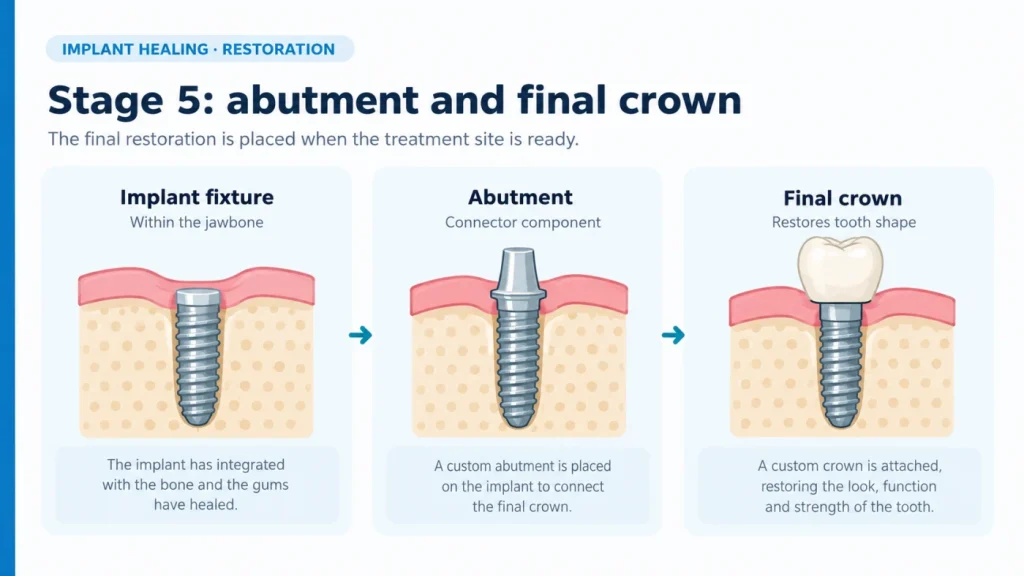
A bridge may be a good option if the teeth next to the gap can support it, or if implants are not a suitable or preferred choice.
An implant may appeal to patients whose neighboring teeth are healthy and would otherwise need to be prepared for a bridge. But implants require appropriate bone and healing, and a bridge can make more sense when nearby teeth already need crowns. An exam will help sort out the tradeoffs.
For a tooth-supported bridge, we check the supporting teeth and bite, prepare the teeth, and take impressions or scans. A temporary restoration may be needed while the final bridge is made. Implant-supported bridges follow a different surgical and restorative process.
Brush twice a day and clean beneath your bridge daily. Special floss threaders, interdental brushes or a water flosser may help you reach the space underneath.
A bridge that feels loose, hurts when you bite or traps food more than usual should be checked. Bleeding gums or sensitivity around a supporting tooth also deserve attention. The problem might be the bridge, a supporting tooth or the gums.
The artificial replacement tooth itself cannot develop decay, but the natural teeth supporting a bridge still can. Decay or gum disease around the supporting teeth can compromise the restoration.
There is no guaranteed lifespan. Longevity depends on the condition of the supporting teeth, bite, hygiene, decay risk, materials and other clinical factors.
The cost depends on how many teeth are replaced, how many units are needed, the materials, the supporting teeth or implants and any additional treatment. PPO benefits may cover part of some procedures, depending on your plan. NewStar Dental can provide an individualized estimate after examination and review of available benefits.
Choosing NewStar Dental means selecting a trusted provider committed to excellence. Our comprehensive approach to cosmetic dentistry ensures that you receive personalized care in a comfortable, welcoming environment. With Dr. Severchenko’s extensive training and our state-of-the-art technology, you can be confident in achieving your best smile. Don’t wait any longer—transform your smile and your life today by contacting NewStar Dental in Fort Lauderdale, FL!
*New patients only. Please confirm offer eligibility and details when booking.